Loading details…

Artist
Johann Joseph Fux
12+ albums
baroqueClassicalcomposeraustrianAustria
about
Johann Joseph Fux (pronounced [fʊks]) (1660 – February 13, 1741) was an Austrian composer, music theorist and pedagogue of the late Baroque era. He is most famous as the author of Gradus ad Parnassum, a treatise on counterpoint, which has become the single most influential book on the Palestrina style of Renaissance polyphony. Almost all modern courses on Renaissance counterpoint, a mainstay of college music curricula, are indebted in some degree to this work by Fux. Life Fux was born to a peasant family in Hirtenfeld in Styria. Relatively little is known about his early life, but likely he went to nearby Graz for music lessons. In 1680 he was accepted at the Jesuit university there, where his musical talent became apparent; and he was organist at St Moritz until 1688. Sometime during this period he must have made a trip to Italy, as evidenced by the strong influence of Corelli and Bolognese composers on his work of the time. By the 1690s he was in Vienna, and attracted the attention of Emperor Leopold I with some masses he composed; the emperor was sufficiently impressed by them to assist him with his career after this point. In 1698, Leopold hired him as court composer. Fux traveled again to Italy, studying in Rome in 1700; it may have been here that acquired the veneration for Palestrina which was so consequential for music pedagogy. Fux served Leopold I until his death, and two more Habsburg emperors after that: Joseph I, and Charles VI, both of whom continued to empl
top songs
1
Chi Nel Camin D'onore
1,2632Kaiserrequiem: II. Kyrie
3363Fux: Il fonte della salute, aperto dalla grazia nel calvario K. 293: "Non t'amo per il ciel"
3294Fux: Concentus musico-instrumentalis, Op. 1: Sinfonia No. 2 in F Major: II. La joye des fidels sujets
2715Fux : Rondeau a 7
2706Fux: Concentus musico-instrumentalis, Op. 1: Sinfonia No. 2 in F Major: III. Aria italiana - Aire francoise
2047Fux: Concentus musico-instrumentalis, Op. 1: Sinfonia No. 2 in F Major: IV. Les enemis confus
1978Fux: Concentus musico-instrumentalis, Op. 1: Serenada a 8: XII. Rigadon
1939Fux: Concentus musico-instrumentalis, Op. 1: Serenada a 8: XVI. Final. Poco allegro
16410Rondeau À 7 in C Major for Violino Piccolo, Bassoon, Strings and Basso Continuo Fedf 111
134albums
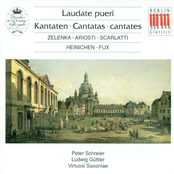
Zelenka, J.D.: Laudate Pueri / Ariosti, A.: O Quam Suavis Est / Scarlatti, A.: Su Le Sponde Del Tebro / Heinichen, J.D.: Lamentation No. 1
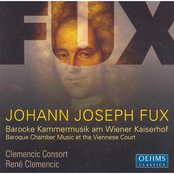
Fux: Chamber Works
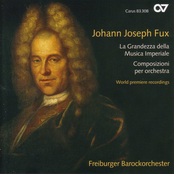
Fux, J.: Overture in D Major / Le Dolcezze, E L'Amerezze Della Notte / Intrada in C Major / Suite in C Major
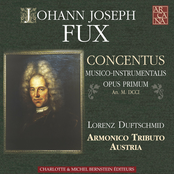
Fux: Concentus musico-instrumentalis
▥
A Cavalier's Tour (Through Baroque Europe)
▥
THE ART OF THE BAROQUE TRUMPET, Vol. 3
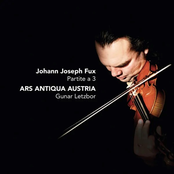
Fux: Partite a 3
▥
Music at the Habsburg Court (DAW 50)
Fux : Serenada, Rondeau & Sonata a 4 (Apex)
▥
Johann Joseph Fux: La Grandezza della Musica Imperiale. Composizioni per orchestra
Fux: Complete Music for Harpsichord
Fux: Sacred Works