Loading details…

Artist
Jean Boyer
12+ albums
frenchbaroqueClassicalAllviol
about
Jean Boyer (born before 1600 – died 1648) was a French viol player and composer, active in Paris during the first half of the 17th century. He must not be confused with Noël Boyer, who was master of the music of the Duchess of Savoy and who in 1631 attempted to succeed Paul Auget [fr] as superintendent of the music of the king's chamber. The first mention of Jean Boyer is when he intervened regarding his cousin Jehan Bernard (c. 1631 – after 1711), who resigned his duties as cantor of the King's Chamber and Chapel in Jean's favor. The act specifies that Jean Boyer was son of the late Philibert Boyer, prosecutor in the court of Parliament, and that he was "experienced in the art of music, even on the lute and on the viols". It was not until February 1617 that he appeared in ballets de cour, composing that year an aria for an unidentified ballet and another for the Ballet des Forgerons. He contributed to other ballets: in 1618 an air for the "Ballet de la Folie" and another for the "Ballet de M. de Nemours", in 1621 an air for an unidentified ballet and another for the "Ballet des Indiens", finally in 1626 for the Ballet du Grand bal de la Douairière de Billebahaut. The dedication of his books of arias published in 1619 and 1621 shows that he probably worked for Henri I, Duke of Nemours (1572–1632), who was the usual ordonnator of the king's ballets, and who might have introduced him to the court in a more active manner than his cantor's office permitted him. On 13 Decembe
top songs
1
Airs à quatre parties, Livre I: Que feray-je?
3172Absent de vos beaux yeux
313Si j'aime autre que vous
304Beau, voyant votre douceur
255Sarabande
226Filandre à rauy mon cœur / Iris, voulez vo' toujours vivre sous la dure loi du devoir ? / Je n'ay rien veu dessous les cieux qui m'aye dompté de ses armes / L'autre jour dessus la fougère
217Que faisais-tu, gros garçon
208Je suis à présent à moi
199Que ferai-je ? Que dirai-je ?
1910Rigoureux souvenir d'une joie passée
19albums
▥
Cœur, airs de cour français de la fin du XVIe siècle
▥
Chansons à boire et à danser: Airs de cour
▥
Chansons à boire et à danser - Airs de cour
▥
Cœur: French Courtly Songs from the Late 16th Century
▥
Salve regina-Musiques festives mariales du grégorien au 17e siècle
▥
Mendelssohn-Oeuvres vocales
▥
L'Astrée: Musiques d'après le roman d'Honoré d'Urfé
▥
Francia [Disc 3]
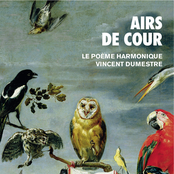
Airs de cour
Yasujiro Ozu ga Aishita Ongaku Disc 1
▥
Schellack Schätze: Treasures on 78 RPM from Berlin, Europe and the World, Vol. 39
▥
Salve Regina - Musiques Festives Mariales Du Grégorien Au 17E Siècle