Loading details…

Artist
Teresa Milanollo
3+ albums
femaleitalianromantic periodromanticwomen composers
about
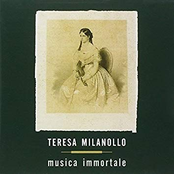
Teresa (1827–1904) and her younger sister Maria (1832–1848) Milanollo, were Italian violin-playing child prodigies who toured Europe extensively to great acclaim in the 1840s. After Maria died at age 16, Teresa, who was also a composer, had a long solo career. The name "Milanollo" has been perpetuated by the regimental march of the Life Guards, Coldstream Guards and Governor General's Foot Guards, written in their honour by their contemporary J.V. Hamm. The Teatro Milanollo in their native Savigliano was named for the sisters. Taught violin in infancy by Ferrero, Caldera, and Morra, Teresa made her concert debut in her native Savigliano aged nine. In 1836 she moved to Paris with her family. She toured Britain, France, the Netherlands and Belgium, sometimes with her virtuoso tutors, Lafont, subsequently Habeneck and later still, de Bériot. She eventually became her sister Maria's first and only violin coach. From 1838 to 1848 the Milanollo sisters toured throughout France, the Netherlands, Belgium, Germany, the Austro-Hungarian Empire, and England, charming royal courts and such composers as Johann Strauss the Elder, Berlioz, Liszt, Chopin and Meyerbeer. Their nicknames, "Mademoiselle Staccato" (Maria) and "Mademoiselle Adagio" (Teresa) reflected their contrasting personalities; the more solemn Teresa was acknowledged as the genius of the two. After Maria Milanollo's untimely death in 1848, Teresa continued performing solo, establishing a system of "Concerts aux Pauvres" (cha
top songs
1
Grande fantaisie élégiaque, Op. 1: I. Introduzione
212Impromptu, Op. 8
83Grande fantaisie élégiaque, Op. 1: IV. Finale
64Impromptu for Violin & Piano, Op. 8
55Lamento, Op. 7
56Grand adagio élégiaque in memoria della Sorella Maria
47Grande fantaisie élégiaque, Op. 1: III. Grande fantaisie élégiaque
48Ave Maria, Op. 4
49Variazioni umoristiche su l'aria di Marlborough, Op. 5
410Variazioni umoristiche sul Rheinweinlied, Op. 6
4