Loading details…

Artist
Robert Wittinger
12+ albums
contemporary classicalcomposerhungaryContemporarygammarec
about
Robert Wittinger was born at Knittelfeld in Austria in 1945, but grew up in Budapest. He belongs to the youngest generation of Hungarian composers. He was strongly influenced by Zsolt Durko in Budapest, by impressions gathered during a visit to Warsaw in the autumn of 1961, and Eby the 1965 International Holiday Course for New Music in Darmstadt. His decision to stay in the Federal Republic of Germany was dictated more by musical and economic considerations than by political ones. His first scores were received with warm interest. A progressive Professor at a Music Academy said of Wittinger's Symphony No. 1, dedicated to Arthur Honegger, that it was "absolutely perfect from the point of view of tomposition technique". After a difficult first period, 1957 brought four first performances. Michael Gielen was one of the first musicians to take up Wittinger. He received two impressive commissions in 1968: for the Donaueschingen Music Festival and for the Darmstadt Holiday Course. He completed five new scores in 1969. 1970 brought another five first performances, one of which was in Darmstadt. This meant that Wittinger had become one of the most sought-after young composers in Germany. He had achieved this with twenty compositions in only eight years. Wittinger's musical language is one of balanced contrasts. Thus taste, elegance, stylization, and - in keeping with the basic principle of balance - the proportionment of the sections of each work, in other words, what is normally ca
top songs
albums
▥
AGP86
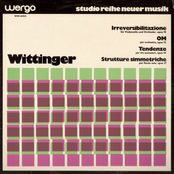
Irreversibilitazione / OM / Tendenze / Strutture Simmetriche
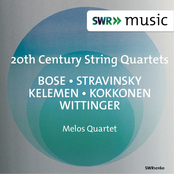
20th Century String Quartets
▥
ROBERT WITTINGER: Maldoror-Requiem, Op. 42
▥
Zeitgenössische Musik 5
▥
Maldoror-Requiem, Op. 42
▥
Irreversibilitazione; OM; Tendenze; Strutture simmetriche
▥
Maldoror-Requiem
▥
Maldoror-Requiem (Soloists, Stuttgart RSO, Eotvos)
▥
Robert Wittinger: Violin Concerto, Op. 43, String Trio, Op. 39 & Violin Sonata, Op. 46
▥
Robert Wittinger (agp086)
▥
Symphony No. 3 'Sinfonia funèbre' op. 37