Loading details…

Artist
Masao Ohki
12+ albums
AsianjapaneseClassicalcontemporary classicalcomposer
about
Masao Ohki was a Japanese composer. He was born on 3rd October 1901 in Iwata, a small provincial city on the Pacific coast in central Japan, and grew up in the larger nearby city of Shizuoka. His father was a teacher at a girls' high school and he spent his childhood during a period when westernisation was bringing an interest in western music, with operas and orchestral concerts occasionally heard in big cities like Tokyo. The circumstances in provincial cities were different. There were only a few pianos in Shizuoka and not even a small orchestra. Musical interest was mainly in Japanese traditional works. Ohkiís father liked to play the shakuhachi, a bamboo flute, and Ohki himself played it from his childhood. With unstable pitch and a mysteriously cloudy, somewhat husky timbre, the instrument has especially been associated with asceticism and Zen meditation. The experience of shakuhachi music was to exert a significant influence on Ohkiís own work. At the same time he had some experience of western instruments, and was able to hear recordings of classical Chinese operas and arias from Bizetís Carmen, as well as a variety of Japanese traditional music. The basis of Ohkiís melodies was always the shakuhachi music and the recordings he heard, and, above all, Japanese traditional music. After completing his junior schooling in 1910, Ohki went on to technical senior high school in Osaka and majored in chemistry. He was now able to study the shakuhachi with master-players, and
top songs
1
Japanese Rhapsody
4952Symphony No. 5, "Hiroshima": I. Prelude
1003Symphony No. 5, "Hiroshima": II. Ghosts: It was a prosession of ghosts
734Symphony No. 5, "Hiroshima": III. Fire: Next moment fire burst into flames
725Symphony No. 5, "Hiroshima": IV. Water: People wandered around seeking for water
596Symphony No. 5, "Hiroshima": V. Rainbow: All of a sudden black rain poured over them and then appeared a beautiful rainbow
597Symphony No. 5, "Hiroshima": VII. Atomic Desert: Boundless desert with skulls
568Symphony No. 5, "Hiroshima": VI. Boys and Girls: Boys and girls died without knowing any joy of human life and calling for their parents
519Symphony No. 5, "Hiroshima": VIII. Elegy
4610VIII. Elegy
18albums
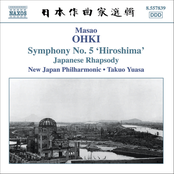
Ohki: Japanese Rhapsody / Symphony No. 5, 'Hiroshima'
Rhapsodie japonaise
▥
Symphony No. 5, "Hiroshima" / Japanese Rhapsody (New Japan Philharmonic Orchestra, Takuo Yuasa)
▥
Japanese Rhapsody/Symphony No.5, 'Hiroshima'
▥
Japanese rhapsody & Symphony No. 5 'Hiroshima'
▥
Symphony No. 5, "Hiroshima"
▥
Japanese rhapsody & Symphony No. 5'Hiroshima'
▥
Japanese Rhapsody & Symphony No. 5"Hiroshima"
▥
Symphony No5 Hiroshima
Symphony No. 5 'Hiroshima'
▥
Ohki : Japanese Rhapsody / Symphony No.5 "Hiroshima"
▥
Ohki: Symphony No. 5 "Hiroshima", Japanese Rhapsody (Yuasa, New Japan Philharmonic)