Loading details…

Artist
Elena Firssowa
4+ albums
freepurp1egammarec
about
Elena Olegovna Firsova (Елена Олеговна Фирсова, Yelena or Jelena Firssowa) (born 21 March 1950) is a Russian composer. She was born in Leningrad into the family of physicists Oleg Firsov and Viktoria Lichko. She studied music in Moscow with Alexander Pirumov, Yuri Kholopov, Edison Denisov and Philip Herschkowitz. In 1979 she was blacklisted as one of the "Khrennikov's Seven" at the Sixth Congress of the Union of Soviet Composers for unapproved participation in some festivals of Soviet music in the West. She is married to the composer Dmitri Smirnov and they currently live in the United Kingdom. She composed more than a hundred compositions in many different genres including chamber opera The Nightingale and the Rose after Oscar Wilde and Christina Rossetti (premiered at the 1994 Almeida Opera Festival, London), an orchestra work Augury, (premiered at the 1992 BBC Proms) that includes a choral setting of William Blake’s famous lines ‘To see the world in a grain of sand...’ and Requiem to Anna Akhmatova's poem for soprano, chorus and orchestra (premiered at the Berlin Konzerthouse in September 2003). Her favorite genre is a chamber cantata for solo voice and ensemble (or orchestra). Some of them are written to the poems by Alexander Pushkin, Marina Tsvetaeva, Boris Pasternak and Oleg Prokofiev. However, the most of them are setting the poems by her favorite poet Osip Mandelstam that include Earthly Life, Tristia, The Stone, Forest Walks, Before the Thunderstorm, Stygian Song,
why this is interesting
# Elena Firssowa This composer's work invites sustained attention for its intellectual rigor and historical courage. Firssowa synthesizes serial techniques with Russian musical tradition, creating soundscapes that feel both structurally precise and emotionally resonant. Her music emerged from Soviet-era constraints—she was blacklisted for her artistic independence—yet never retreats into protest or didacticism. Instead, her compositions explore abstract territories: the relationship between sound and silence, timbre as structural material, the expressive possibilities within strict formal systems. Her output reveals a mind genuinely curious about music's fundamental questions, asking listeners to engage similarly rather than passively receive.
top songs
1
Suita Op 2 for viola solo - II Andante
42Suita Op 2 for viola solo - III Alegretto
43Suita Op 2 for viola solo - IV Moderato con moto
44Elena Firssowa - Suita Op 2 for viola solo - I Moderato con moto espressivo
25Suita Op 2 for viola solo - I Moderato con moto espressivo
26suite op. 2 for viola solo: i. moderato con moto espressivo
17Suite, op. 2/Moderato con moto
18Suite, op. 2/Moderato con moto espressivo
19Suite, op. 2/Andante
110Suite, op. 2/Allegretto
1albums
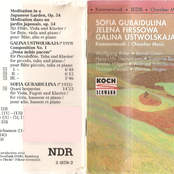
Gubaidulina, Firssowa, Ustwolskaja - Kammermusik
▥
kammermusik
▥
Gubaidulina, Firssowa, Ustwolskaja - Kammermusik : Wolfgang Ritter, Bernd Osten, Hans-Udo Heinzmann, Susanne Barner, Thomas Oepen, Werner Hagen, Walter Hilgers
▥
Chamber Music – Gubaidulina: Quartet for 4 flutes; Quasi hoquetus/ Firsova: Suite, Op.2 for viola solo/ Ustvolskaya: 'Dona nobis pacem' [Ritter; Osten; Heinzmann; Barner, flutes/ Hilgers, tuba/ Schoberansky, bassoon/ Oepen, viola/ Hagen, piano]