Loading details…

Artist
Eddie "One String" Jones
12+ albums
bluesamericanstreet musiciancountry blues
about
Eddie "One String" Jones was an American country blues unitar player and vocalist who was active in Los Angeles, California. Little to nothing is known about Jones's personal background -- his name may have not even been Eddie Jones, but rather Jesse Marshall -- yet he is remembered for his 1960 recordings that appeared on an album, along with work by fellow musician Edward Hazelton. Jones's musicianship is regarded as a link between American blues and original elements of African music. Jones drifted to Los Angeles to work as a street performer in a poor district of the city known as Skid Row. Relying partially on the novelty of the unitar, which he crudely assembled with a piece of timber wood, one broom wire stretched across it, and a tin can mounted on the end, Jones gave no indication that the instrument or his technique were anything but peculiar to himself.[1] Music historian David Campbell expounded on how Jones played the unitar, writing, "He played it by sliding a half-pint bottle along the wire with his left hand, while striking it near the resonating can with a little whittled stick in his right hand".[2] It is directly related to the diddley bow, which in itself derived from West African instruments; however, Jones's practice of percussively sounding the resonator, and unorthodox sliding was far removed from known slide and bottleneck techniques.[3] In 1960, Jones approached record producer Frederick Usher Jr., with his unitar in hand. Usher had been investigat
top songs
albums
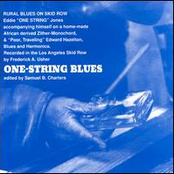
One String Blues
▥
One-String Blues
▥
Blues Masters Vol.10 Blues Roots
▥
Blues Masters, Vol. 10: Blues Roots
▥
Takoma Slide
▥
Blues Masters, Vol. 18: More Slide Guitar Classics
▥
Blues Masters, Volume 18: More Slide Guitar Classics
▥
One-String Blues: Rural Blues On Skid Row
▥
Rolling And Tumbling: Acoustic Blues
▥
Acoustic Slide Blues
▥
House of Blues - Essential Blues Guitar (Disc 2)
▥
Guitar Boogie Fever