Loading details…

Artist
Duarte Lobo
12+ albums
renaissanceearly musicClassicalportuguesebaroque
about
Duarte Lôbo (c. 1565 – 24 September 1646; Latinized as Eduardus Lupus) was a Portuguese composer of the late Renaissance and early Baroque. He was one of the most famous Portuguese composers of the time, together with Filipe de Magalhães, Manuel Cardoso, composers who all began their academic studies as students of Manuel Mendes. Along with King João IV of Portugal they represent the "golden age" of Portuguese polyphony. Details of his life are sparse. He was born in Alcáçovas, in Alentejo, southern Portugal. He is known to have been a choir boy at Évora where he subsequently studied with Manuel Mendes . His first position was as mestre de capela of the cathedral of Évora; sometime before 1589, he became maestro di cappella at the Hospital Real, Lisbon. By 1591 he was appointed as mestre de capela at the cathedral in Lisbon, a position he held till 1639. This was the most prestigious musical appointment in the country. He also served as director of the Seminar of St. Bartholomew, and was also a professor of music at the 'Colégio do Claustro da Sé' (College at the Holy See Cloisters) in Lisbon, where he taught Manuel Machado. While chronologically his life overlapped with the beginning of the Baroque music era, he was a rather conservative composer who followed the techniques of the Renaissance masters of the previous generation. Palestrina's polyphonic style played a crucial role in his compositions throughout his life. Published by Plantin in Antwerp, his six books of sa
top songs
albums
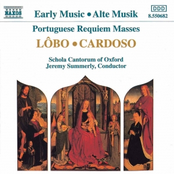
LOBO, D. / CARDOSO: Portuguese Requiem Masses
▥
Portuguese Polyphony
▥
Victoria / Lobo / Lasso: Masses
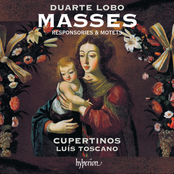
D. Lobo: Masses, Responsories & Motets
▥
Renaissance Portugal
▥
Saints and Sinners - The Music of Medieval and Renaissance Europe
▥
Owen Rees, Paradisi Portas: Music From 17th Century Portugal
▥
Vecchi: Requiem – Rubens's Funeral & The Antwerp Baroque
▥
Portuguese Vocal Masterpieces of the 16th & 17th Centuries, Vol. 1
▥
VICTORIA / LOBO / LASSUS: Masses
▥
Music for an Antwerp Church
▥
Requiem