Loading details…

Artist
Antonio Cifra
10+ albums
italian17th century
about
Antonio Cifra (1584? – Loreto, 2 October 1629) was an Italian composer of the Roman School of the Renaissance and early Baroque eras. He was one of the significant transitional figures between the Renaissance and Baroque styles, and produced music in both idioms. Son of Costanzo and Claudia, Antonio Cifra was born perhaps in Bassiano (near Terracina).[1] He studied with Giovanni Bernardino Nanino from 27 June 1594 at San Luigi dei Francesi in Rome and then, from 18 January 1597, he was boy soprano of the Cappella Giulia at St Peter. From 1605 to 1607 he was maestro at the Roman Seminary, and from 1608 to 1609 he held the same position at the German College in Rome. In 1609 he was hired as maestro di cappella at Santa Casa in Loreto, where he remained the rest of his life. Cultural connections between Loreto and Rome were close (since Loreto was a pilgrimage destination), and he maintained contact with the composers in Rome during this period. Near the end of his life he took part in several large musical events in Rome, including a large Vespers at St. Peter's for which he batteva (beat time) for [2] one of the choirs. Cifra was a prolific composer, with 45 separate publications to his credit: they included psalms, motets, litanies, Scherzi sacri, masses, polychoral motets, and sacred songs, as well as secular music including madrigals in both the Renaissance a cappella and Baroque concertato forms. Stylistically, Cifra's music varies between masses in the Palestrina style, w
top songs
albums
▥
Combattimento Di Tancredi E Clorinda Et Madrigaux De La Gerusalemme Liberata
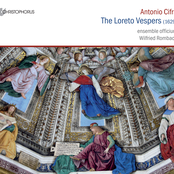
Cifra: The Loreto Vespers
▥
Teatro spirituale (Rome C. 1610)
▥
Songs for Courtiers and Cavaliers
▥
The Heritage of Monteverdi (V): Per il Santissimo Natale
▥
Combattimento di Tancredi e Clorina et madrigaux de la Gerusalemme Liberata (Ensemble Elyma mit. Dirigent: Gabriel Garrido)
▥
Per il Santissimo Natale
▥
The Heritage of Monteverdi
▥
Gerusalemme Liberata: Les Larmes De Jerusalem
▥
Praetorius and Italy