Loading details…
Album
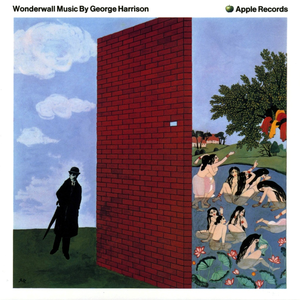
Wonderwall Music
George Harrison →27,411 listeners478,657 plays
instrumentalpsychedelicclassic rock1968rock
about this album
Wonderwall Music is the debut solo album by the English musician George Harrison and the soundtrack to the 1968 film Wonderwall, directed by Joe Massot. Released in November 1968, it was the first solo album by a member of the Beatles, and the first album issued on the band's Apple record label. The songs are mostly instrumental pieces, with some featuring non-English language vocals and one track with English lyrics, mostly short musical vignettes. Following his Indian-styled compositions for the Beatles since 1966, he used the film score to further promote Indian classical music by introducing rock audiences to instruments that were relatively little-known in the West – including shehnai, sarod, tar shehnai, tanpura and santoor. The Indian pieces are contrasted by Western musical selections, in the psychedelic rock, experimental, country and ragtime styles. Harrison recorded the album between November 1967 and February 1968, with sessions taking place in London and Bombay. One of his collaborators on the project was classical pianist and orchestral arranger John Barham, while other contributors include Indian classical musicians Aashish Khan, Shivkumar Sharma, Shankar Ghosh and Mahapurush Misra. The Western music features contributions from Tony Ashton and his band the Remo Four, as well as guest appearances by Eric Clapton and Ringo Starr. Harrison recorded many other pieces that appeared in Wonderwall but not on the soundtrack album, and the Beatles' 1968 B-side "The Inn
why this is interesting
# Wonderwall Music This 1968 album deserves consideration as a genuinely curious artifact—Harrison's first solo work and Apple Records' inaugural release. Rather than pursuing the conventional path of a rock frontman, he created something entirely instrumental, a film score that functions as a sustained meditation on Indian classical music. The pieces function as vignettes, each brief and distinct, yet collectively they form something coherent: an earnest exploration of a musical tradition largely unfamiliar to Western listeners at the time. What's striking is Harrison's refusal to compromise or simplify; these aren't exotic arrangements grafted onto pop structures, but genuine engagements with sitar, tabla, and vocal traditions. The album reveals an
tracks
13:3921:5631:0444:0553:0861:0271:2781:5091:1510114:20124:15131:12141:22151:43161:03172:15181:23191:53
Microbes
George Harrison
Red Lady Too
George Harrison
Tabla and Pakavaj
George Harrison
In the Park
George Harrison
Drilling a Home
George Harrison
Guru Vandana
George Harrison
Greasy Legs
George Harrison
Ski‐ing
George Harrison
Gat Kirwani
George Harrison
Dream Scene
George Harrison
Party Seacombe
George Harrison
Love Scene
George Harrison
Crying
George Harrison
Cowboy Music
George Harrison
Fantasy Sequins
George Harrison
On the Bed
George Harrison
Glass Box
George Harrison
Wonderwall to Be Here
George Harrison
Singing Om
George Harrison