Loading details…
Album
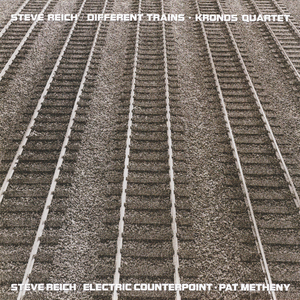
Different Trains
Steve Reich →37,734 listeners127,865 plays
minimalismtrainsnot electronicavant-gardeminimal
about this album
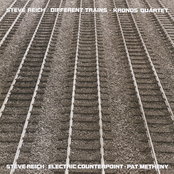
Different Trains is a three-movement piece for string quartet and tape written by Steve Reich in 1988. It won a Grammy Award in 1990 for Best Contemporary Classical Composition. The work's three movements have the following titles: America-Before the War (movement 1) Europe-During the War (movement 2) After the War (movement 3) During the war years, Reich made train journeys between New York and Los Angeles to visit his parents, who had separated. Years later, he pondered the fact that, as a Jew, had he been in Europe instead of the United States at that time, he might have been travelling in Holocaust trains. Steve Reich's earlier work had frequently used tape, looped and played back at different speeds. However, Different Trains was a novel experiment, using recorded speech as a source for melodies. This followed Scott Johnson's John Somebody of 1978, an early attempt to construct directed melodic motion by harmonising recorded speech. In Different Trains, after each melody in the piece is introduced, usually by a single instrument (viola for women and cello for men), a recording of the spoken phrase from which the melody derives is played. The melody is then developed for a while, with the instruments playing along with the recording of the phrase or part of the phrase. The music for the strings makes extensive use of paradiddles rhythms, with alternating pitches instead of alternating drum sticking. In addition to speech, the piece includes recordings of train sounds, as
tracks
18:5827:30310:3547:1753:5163:39710:0882:1495:33105:13
Different Trains (I. America - Before the War)
Orchestre National de Lyon
Different Trains (II. Europe - During the War)
Orchestre National de Lyon
Different Trains: III. After the war
Orchestre National de Lyon
Triple Quartet, No. I
Orchestre National de Lyon
Triple Quartet, No. II
Orchestre National de Lyon
Triple Quartet, No. III
Orchestre National de Lyon
The Four Sections, No. I
Orchestre National de Lyon
The Four Sections, No. II
Orchestre National de Lyon
The Four Sections, No. III
Orchestre National de Lyon
The Four Sections, No. IV
Orchestre National de Lyon