Loading details…
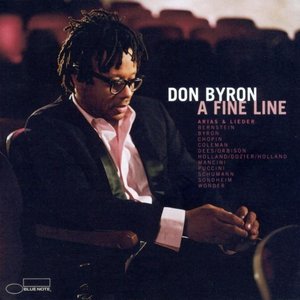
Album
A Fine Line
Don Byron →2,440 listeners8,251 plays
gammareccontemporary jazzvocal jazzjazzclarinet
about this album
Review by David R. Adler Arias and lieder are forms strongly associated with classical music, yet clarinetist Don Byron defines them in a newly expansive way for this remarkable project. To Byron, arias and lieder belong not only to classical figures, but also to writers as diverse as Ornette Coleman, Roy Orbison, Stevie Wonder, Henry Mancini, and Stephen Sondheim. Byron's right-hand man in this endeavor is pianist Uri Caine. The two play a series of duets throughout the program: "Zwielecht (Twilight)" by Robert Schumann, "Basquiat" by Byron himself, "Nessun Dorma" by Puccini, and "Reach Out (I'll Be There)," the 1966 Holland/Dozier/Holland hit sung by the Four Tops. Byron concludes the album with a solo clarinet rendition of the "Larghetto" from Chopin's second piano concerto. These duo and solo vignettes frame the full ensemble pieces, on which Byron and Caine are joined by Jerome Harris, Paulo Braga, and a number of very effective guest vocalists. Former Pat Metheny Group vocalist Mark Ledford is wispy and ethereal on Ornette Coleman's "Check Up," deep-toned and far more dramatic on Roy Orbison's "It's Over." Patricia O'Callaghan takes a turn on Leonard Bernstein's "Glitter and Be Gay," an epic piece which Byron infuses with a strong dose of calypso. Both vocalists are joined by Dean Bowman and Harris to form a four-voice choir on Henry Mancini's "Soldier in the Rain." And finally, the great Cassandra Wilson turns in a spellbinding performance on Stephen Sondheim's
tracks
110:1022:5338:0645:0652:4264:5473:5983:4894:52106:20112:15
Check Up
Ornette Coleman
Zwielicht (Twilight)
Don Byron
Glitter And Be Gay
Don Byron
Basquiat
Don Byron
It's Over
Don Byron
Creepin'
Don Byron
Nessun Dorma
Don Byron
Soldier In The Rain
Don Byron
Reach Out I'll Be There
Don Byron
The Ladies Who Lunch
Don Byron
Larghetto
Don Byron